“We can't just stop with a single terrorist or a single terrorist organization; we have to go and root out the whole system. We have to go after poverty.”
-Colin Powell, former U.S. Secretary of State and retired 4-Star General of the U.S. Army
Every week, I teach an English lesson at a vocational school for war-affected youth in Northern Uganda. One day, as most of my students concentrated on answering their writing prompt, a new student asked if he could practice his English with me through conversation.
Otim began by telling me about himself. He shared about how the war in Northern Uganda had affected his family and how he was abducted by the LRA for two years. When he returned to his village, he found his father had been killed by the militia and his family was now too poor to pay his school fees.
When it came time for Otim to ask me questions, he began by inquiring about the Peace Club I lead at the center, a group he heard about from his friends. “What exactly do you do?” he asked. I explained that I aim to empower the youth with tools to help them create peace for themselves and their community, and I gave examples of the kinds of projects we undertake and skills we develop.
“Excuse me, Madame, I understand what you are saying, but you see, for me, I cannot have peace for myself until I know I can have a future. And I cannot know I will have a good future until I find a way to afford an education. Without an education, the children I will someday have will suffer just like I did. So how can you help me find peace?”
His inquiry was profound.
In a war-affected community where the economy was devastated by 20 years of insecurity, education suffers, and without education, the prospects for a productive peaceful, future are bleak.
How could I expect Otim to feel peace if he does not believe he stands a chance at making a livable income to afford his own needs and those of his dependents? If another terrorist militia swept through the North with promises of a better future for Acholis who chose to join, would Otim pick up a weapon?
When I co-founded Kids for Peace in 2006, I was highly influenced by my own upbringing during the period of fear following 9/11 and the wars against terrorism that followed. At 12 years old, I learned something that changed me, and which I still think of often today: many of the terrorists responsible for the 9/11 attacks were war orphans or living in extreme poverty resulting from the Soviet invasion of Afghanistan (Bhutta 2002). When war-affected populations—and in particular, children—are left with memories of violence and few chances for improving their circumstances, a culture conducive to terrorism, extremism, and violence can form.
For years, foreign policy leaders have recognized this connection, yet little has changed in the way we approach national security. We continue to spend a relatively minute portion of our federal budget on creating security abroad through development relative to defensive spending. In 2010, the United States federal budget allotted 19% of its total expenditures to the U.S. Department of Defense, while only 0.39% went to poverty-focused development assistance (Borgen Project). According to the Center for Strategic and Budgetary Assessments, the federal budget for 2012 proposes the greatest spending on defence since World War II (Business Insider).
In the absence of strong government-led development efforts, NGOs have attempted to fill the gap, with many organizations working to empower violence-affected communities. One effort recently featured on Kristof's New York Times blog is led by Jake Harriman, a former US Naval Academy graduate who spent 7 years in the U.S. Marines. After two deployments to the frontlines of the War on Terror, Harriman decided to enroll in Stanford Business School to develop skills to enable him to create an organization aimed at combating terrorism through poverty alleviation.
Harriman’s story is moving and his efforts are worthwhile, but his impact will inevitably be restricted by the same limitations of capacity nearly all NGOs face. With limited time and resources, Harriman's organization, Nuru International, has chosen to focus its current efforts on the Kuria District in Kenya through an ambitious plan to create social change in that community. Other organizations with similar missions are chipping away at the problem of extreme poverty in other regions of the world, but the reality persists that NGOs simply lack the capacity to solve global poverty alone.
Campaigns for ending poverty like ONE and Make Poverty History have lobbied world leaders and created the economic case to demonstrate that the resources exist for improving the futures of the world’s poor if only the international will existed to make necessary changes that would allow them to do so.
Without a fundamental restructuring of the way powerful countries think about national security, poor communities will continue to breed the type of ignorance that serves as a barrier to peace and an incubator for insecurity. Without access to education for young men like Otim, warlords like Joseph Kony will continue to be able to indoctrinate militias in world views based upon irrationality and violence. Organizations like Nuru make an important step in the right direction, but for the kind of widespread change necessary to create cultures conducive to peace, foreign policies of the world's most powerful nations must adapt to offer greater assistance to the world's most poor.
Showing posts with label Violence. Show all posts
Showing posts with label Violence. Show all posts
Thursday, March 15, 2012

Tuesday, October 25, 2011
Make me an instrument of peace
For many years, I have hung the Prayer of St. Francis in a place where I can see it when I wake to remind myself that each day can begin with the intention of promoting kindness.
When I arrived in Pader, I knew little about the village outside of what history books and human rights reports shared about the brutal violence which occurred in the region: the dismemberment of bodies, the killing, the abduction of children. I came with no set plan of action, but with an open mind and a willingness to give of my time and skills.
After my first two weeks teaching at FRO’s rehabilitation center, I approached community leaders with an explanation of my prior experience in peace building work and asked about their perceptions of what is most needed to promote sustainable peace and development in Pader. Their answer was unanimous: work to educate our most vulnerable children.
In the days following, I tirelessly labored over (and might I admit, stressed about) a plan to educate 1500 primary school children identified by a coalition of international NGOs as the most vulnerable and war-affected. All of these children are fully or partially orphaned, many were abducted by the LRA, and most care for themselves and siblings. None could access education without the support of donors to cover the expense of school fees, uniforms, school materials, and a basic living allowance.
I learned that it costs $30/year to cover all of the expenses associated with a child’s school attendance in Uganda, less than I spend in one night of dinner and a movie back home. For less than $8,000 more/year, the entire program supporting 1500 children in 56 Northern Ugandan primary schools could be administered and have all operational costs covered.
After agreeing to find funding to support this program, I was greeted with another request: help bring peace education to schools in Northern Uganda. I jubilantly accepted this challenge after seeing how happily the Kids for Peace Peace Pledge was received. Over the next few months, I will work to support peace education beginning with the most local primary schools and eventually reaching several more remote schools in areas that once served as battlegrounds for the terror waged by the LRA.
The enormity of the challenges I am facing here are at times overwhelming. While I’m constantly hearing about new “causes” to support here and realizing that one person can only do so much, I know that even so, all people can begin the day with the intention of doing the most they can to foster peace and spread hope.
The Prayer of St. Francis
Lord, make me an instrument of your peace.
Where there is hatred, let me sow love.
Where there is injury, pardon.
Where there is doubt, faith.
Where there is despair, hope.
Where there is darkness, light.
Where there is sadness, joy.
O Divine Master,
grant that I may not so much seek to be consoled, as to console;
to be understood, as to understand;
to be loved, as to love.
For it is in giving that we receive.
It is in pardoning that we are pardoned,
and it is in dying that we are born to Eternal Life.
When I arrived in Pader, I knew little about the village outside of what history books and human rights reports shared about the brutal violence which occurred in the region: the dismemberment of bodies, the killing, the abduction of children. I came with no set plan of action, but with an open mind and a willingness to give of my time and skills.
After my first two weeks teaching at FRO’s rehabilitation center, I approached community leaders with an explanation of my prior experience in peace building work and asked about their perceptions of what is most needed to promote sustainable peace and development in Pader. Their answer was unanimous: work to educate our most vulnerable children.
In the days following, I tirelessly labored over (and might I admit, stressed about) a plan to educate 1500 primary school children identified by a coalition of international NGOs as the most vulnerable and war-affected. All of these children are fully or partially orphaned, many were abducted by the LRA, and most care for themselves and siblings. None could access education without the support of donors to cover the expense of school fees, uniforms, school materials, and a basic living allowance.
I learned that it costs $30/year to cover all of the expenses associated with a child’s school attendance in Uganda, less than I spend in one night of dinner and a movie back home. For less than $8,000 more/year, the entire program supporting 1500 children in 56 Northern Ugandan primary schools could be administered and have all operational costs covered.
After agreeing to find funding to support this program, I was greeted with another request: help bring peace education to schools in Northern Uganda. I jubilantly accepted this challenge after seeing how happily the Kids for Peace Peace Pledge was received. Over the next few months, I will work to support peace education beginning with the most local primary schools and eventually reaching several more remote schools in areas that once served as battlegrounds for the terror waged by the LRA.
The enormity of the challenges I am facing here are at times overwhelming. While I’m constantly hearing about new “causes” to support here and realizing that one person can only do so much, I know that even so, all people can begin the day with the intention of doing the most they can to foster peace and spread hope.
The Prayer of St. Francis
Lord, make me an instrument of your peace.
Where there is hatred, let me sow love.
Where there is injury, pardon.
Where there is doubt, faith.
Where there is despair, hope.
Where there is darkness, light.
Where there is sadness, joy.
O Divine Master,
grant that I may not so much seek to be consoled, as to console;
to be understood, as to understand;
to be loved, as to love.
For it is in giving that we receive.
It is in pardoning that we are pardoned,
and it is in dying that we are born to Eternal Life.
The Faces of Youth
Here in Pader, I spend part of my time teaching at a vocational school operated by Friends of Orphans (FRO) for vulnerable youth. To be admitted to the center, a young person must be a formerly abducted youth (a child soldier or child bride of the LRA), a war orphan, disabled, an AIDS orphan, and/or a child-headed household. Many of my students qualify in more than one way, with the majority once belonging by will or force to the Lord’s Resistance Army.
I cannot picture a single soldier amongst the boys who are kind, courteous, and quick to help me in the classroom. The girls, many of whom leave at lunchtime to feed their children, seem like any other teenage girls, except more responsible and wise to the value and privilege of obtaining an education after having it denied to them for much of their lives.

The classroom can be a distracting place. Several times a day, chickens chase each other across the cement floors, squawking loudly; the wet season’s rains cause a deafening cacophony of sound as water tumults the metal roof, impeding instruction; and intermittent power means I often must teach in dim light, using my lively imagination to come up with adapted lesson plans.

I teach Computers, English and Debate to the vocational school students, and am shocked by some of the stories that surface in our storytelling practice. During free writing exercises, I provide students with simple prompts, like “Tell me about your weekend,” which often result in responses that leave me heart-wrenched for days to come.
One timid teenage girl shared that over the weekend, she was faced with deciding how best to support her 12-year old sister who was raped by a man in the village. My job as an English teacher—to correct the grammar of the stories shared in my class—suddenly seemed trivial as my humanity compelled me to inquire about the steps taken to ensure the health, counseling, and legal support of this young girl.
In the smiling faces of the students, I can tell how deeply they appreciate their educations, the security within the gates of the FRO rehabilitation center, and the healing they are able to experience here. In the furrows of their brows and serious, aged eyes, I am reminded of the cruelty these brave youth faced during wartime and continue to face as they struggle to survive in Pader.

I cannot picture a single soldier amongst the boys who are kind, courteous, and quick to help me in the classroom. The girls, many of whom leave at lunchtime to feed their children, seem like any other teenage girls, except more responsible and wise to the value and privilege of obtaining an education after having it denied to them for much of their lives.

The classroom can be a distracting place. Several times a day, chickens chase each other across the cement floors, squawking loudly; the wet season’s rains cause a deafening cacophony of sound as water tumults the metal roof, impeding instruction; and intermittent power means I often must teach in dim light, using my lively imagination to come up with adapted lesson plans.

I teach Computers, English and Debate to the vocational school students, and am shocked by some of the stories that surface in our storytelling practice. During free writing exercises, I provide students with simple prompts, like “Tell me about your weekend,” which often result in responses that leave me heart-wrenched for days to come.
One timid teenage girl shared that over the weekend, she was faced with deciding how best to support her 12-year old sister who was raped by a man in the village. My job as an English teacher—to correct the grammar of the stories shared in my class—suddenly seemed trivial as my humanity compelled me to inquire about the steps taken to ensure the health, counseling, and legal support of this young girl.
In the smiling faces of the students, I can tell how deeply they appreciate their educations, the security within the gates of the FRO rehabilitation center, and the healing they are able to experience here. In the furrows of their brows and serious, aged eyes, I am reminded of the cruelty these brave youth faced during wartime and continue to face as they struggle to survive in Pader.

Monday, October 24, 2011
“Same, Same, but Different:” Women, Men, and Rural Life
One of my favorite nights in Pader so far, Nighty invited me over for a soda. I am not normally a soda drinker, but with few sugary items available, I jumped at the chance to try a pineapple flavored Novida.
When I arrived, I was hurried into Nighty’s thatched-roof hut, away from the drinking men surrounding who always love my visits. Inside, Nighty had carefully swept her dirt floor and cleared her belongings to make room for three plastic chairs and a worn wooden stool. Her other guests awaited my arrival: her vivacious and opinionated 24 year-old sister named Alice, and her sister’s friend, Sange.
We spent the evening chatting and joking like childhood friends. Outside, Nighty’s customers drank and listened to spirited African music, and every now and then, the women and I would suspend our conversation to teach one another how we would dance to the beat. They laughed and laughed at my attempts at mimicking the tidal movement of their gyrating hips as they demonstrated the traditional dance of the region.
Of course, in a room of young women, the subject of conversation eventually turned to men. Did I have a man? What is dating like in the United States? Do I plan to meet the family of the man I have most recently dated?
I quickly learned that in Northern Uganda, a woman may be courted for as short as a few days or as long as a year before she introduces her suitor to her family for approval and marriage. I explained that I once dated a man for two and a half years, but decided not to marry him, and that I could reasonably date many men in my life for long periods of time before deciding I wanted to marry.
“Why do you think it will take such a long time?” Alice asked. “Western men are supposed to make very good husbands. Me, I am waiting for a Western man. White men know that an African woman will be very obedient and make a good wife, so they like us too.” The others all agreed, they were waiting for Western men to come to the village and ask for their hand in marriage, and even Nighty—the one with children among us—said that she would take up a Western man if she had the chance.
“Why do you like Western men so much?” I asked, amused by their interest in those I am quick to dismiss. I was expecting an answer involving money or looks, the superficial qualities that girls in the U.S. fawn over, but was surprised by their response. “One of the main causes of death for a woman here is beating. Sometimes, a woman is beaten badly, but there is no money for the hospital, so she dies at home. We have heard that Western men do not beat their wives. Also, we are told that they are not players and they do not drink as much.”
Humbled by their response, I agreed that it is not culturally acceptable for a man in America to hit a woman, but I shared that even some men in America do, that others can be “players,” and still others drink too much.
Sipping our pineapple bubbly, we allowed the conversation to return to lighter things, to dancing, travels, and what life is like back home.
When I arrived, I was hurried into Nighty’s thatched-roof hut, away from the drinking men surrounding who always love my visits. Inside, Nighty had carefully swept her dirt floor and cleared her belongings to make room for three plastic chairs and a worn wooden stool. Her other guests awaited my arrival: her vivacious and opinionated 24 year-old sister named Alice, and her sister’s friend, Sange.
We spent the evening chatting and joking like childhood friends. Outside, Nighty’s customers drank and listened to spirited African music, and every now and then, the women and I would suspend our conversation to teach one another how we would dance to the beat. They laughed and laughed at my attempts at mimicking the tidal movement of their gyrating hips as they demonstrated the traditional dance of the region.
Of course, in a room of young women, the subject of conversation eventually turned to men. Did I have a man? What is dating like in the United States? Do I plan to meet the family of the man I have most recently dated?
I quickly learned that in Northern Uganda, a woman may be courted for as short as a few days or as long as a year before she introduces her suitor to her family for approval and marriage. I explained that I once dated a man for two and a half years, but decided not to marry him, and that I could reasonably date many men in my life for long periods of time before deciding I wanted to marry.
“Why do you think it will take such a long time?” Alice asked. “Western men are supposed to make very good husbands. Me, I am waiting for a Western man. White men know that an African woman will be very obedient and make a good wife, so they like us too.” The others all agreed, they were waiting for Western men to come to the village and ask for their hand in marriage, and even Nighty—the one with children among us—said that she would take up a Western man if she had the chance.
“Why do you like Western men so much?” I asked, amused by their interest in those I am quick to dismiss. I was expecting an answer involving money or looks, the superficial qualities that girls in the U.S. fawn over, but was surprised by their response. “One of the main causes of death for a woman here is beating. Sometimes, a woman is beaten badly, but there is no money for the hospital, so she dies at home. We have heard that Western men do not beat their wives. Also, we are told that they are not players and they do not drink as much.”
Humbled by their response, I agreed that it is not culturally acceptable for a man in America to hit a woman, but I shared that even some men in America do, that others can be “players,” and still others drink too much.
Sipping our pineapple bubbly, we allowed the conversation to return to lighter things, to dancing, travels, and what life is like back home.
Monday, October 10, 2011
Welcome to Pader
After a brief stay in Kampala, I began the long journey to Pader,
Northern Uganda. During the ten hour bus ride, I saw the land around
me transform from the semi-tropical and relatively prosperous south to
the increasingly dry, desolate, and poor north. At one point, an
Acholi mother with two young children sat beside me. Her oldest
daughter, roughly 3 years old, laughed and laughed every time she
looked at me. Occasionally, she’d reach out to touch my skin and then
let out a big belly laugh with her sparsely toothed, orange slice
smile, a sweet, innocent reaction to the unknown. Later in the day, I
encountered a younger boy, less than two years old, who looked at me
with a horror-struck countenance and then broke out into tears. I
preferred the little girl’s response.
Pader is one of the most remote regions of Uganda, and was hard hit by
twenty years of Lord’s Resistance Army (LRA) warfare which ended with
a peace agreement in 2008. During its heyday, the LRA abducted an
estimated 60,000 children who were forced to become soldiers and child
brides, and 1.5 million Northern Ugandans were herded into internally
displaced people (IDP) camps, living in notoriously abysmal conditions
for over a decade.
Today, Pader is a graveyard of NGOs, with locals telling ghost stories
of foreign humanitarians who passed through, leaving few remains of
the tens of millions of aid dollars spent here. While NGO buildings
and jeeps sprinkle the town and countryside, the liveliness of these
organizations departed and left in its wake a slew of empty
guesthouses and restaurants.
Food is scarce in this dusty and dry district, so World Food Programme
trucks pass by often, with Food for the Hungry, Mercy Corps, and
several others having some presence here. While many habitations
advertise restaurant services, most are seldom open, and those that
are offer only a small fraction of what is on their menu.
With the coming dry season, the availability of food and water will
become even rarer, introducing me to paucity like I have never before
experienced.
Northern Uganda. During the ten hour bus ride, I saw the land around
me transform from the semi-tropical and relatively prosperous south to
the increasingly dry, desolate, and poor north. At one point, an
Acholi mother with two young children sat beside me. Her oldest
daughter, roughly 3 years old, laughed and laughed every time she
looked at me. Occasionally, she’d reach out to touch my skin and then
let out a big belly laugh with her sparsely toothed, orange slice
smile, a sweet, innocent reaction to the unknown. Later in the day, I
encountered a younger boy, less than two years old, who looked at me
with a horror-struck countenance and then broke out into tears. I
preferred the little girl’s response.
Pader is one of the most remote regions of Uganda, and was hard hit by
twenty years of Lord’s Resistance Army (LRA) warfare which ended with
a peace agreement in 2008. During its heyday, the LRA abducted an
estimated 60,000 children who were forced to become soldiers and child
brides, and 1.5 million Northern Ugandans were herded into internally
displaced people (IDP) camps, living in notoriously abysmal conditions
for over a decade.
Today, Pader is a graveyard of NGOs, with locals telling ghost stories
of foreign humanitarians who passed through, leaving few remains of
the tens of millions of aid dollars spent here. While NGO buildings
and jeeps sprinkle the town and countryside, the liveliness of these
organizations departed and left in its wake a slew of empty
guesthouses and restaurants.
Food is scarce in this dusty and dry district, so World Food Programme
trucks pass by often, with Food for the Hungry, Mercy Corps, and
several others having some presence here. While many habitations
advertise restaurant services, most are seldom open, and those that
are offer only a small fraction of what is on their menu.
With the coming dry season, the availability of food and water will
become even rarer, introducing me to paucity like I have never before
experienced.
Saturday, September 17, 2011
Journeying to Far-away Lands
One of my hopes in Laos was to leave behind streets, tuk-tuks, and voices, and find a place where life is quiet. I had heard about treks to tribal villages out of Muang Ngoi Neua, a small town only accessible by boat, and decided to make my way to the storied place with no automobiles or flushing toilets, and only limited electricity.
Muang Ngoi was first discovered for tourism by a French woman boating up the Mekong in 1988. At the time, her search for a hut to sleep in was met by adversarial faces, with every townsperson shutting their doors as she approached.
Their lack of welcome came from equal parts fear and anger. For nearly twelve years, the people of Muang Ngoi had been forced to live in small caves carved into the local mountains as wars destroyed their tiny village. The worst bombing came from 1968-1969 during the U.S. “Secret War,” when the Ho Chi Minh Trail that ran through Laos was attacked mercilessly by B-52 bombers. Per capita, Laos is the most bombed country in the world, with more bombs dropped in the countryside during the Vietnam War than fell in World War II. As is the case in Cambodia (see post below), approximately one-third of these bombs did not detonate, continuing to contaminate the countryside with dangerous unexploded ordinances.
My guide in Muang Ngoi told me that his brothers and sisters were born in those caves. During a trek through the hills, he showed me the exact cool and damp space on the cave’s floor where his aunt, my host, was born.

Today, resentment has faded as the people of Muang Ngoi and nearby tribal villages understand the economic benefits of tourism. They now have several simple guesthouses and family-run restaurants that welcome travelers from the very countries that made them retreat into caves some forty years ago.

Just outside of Muang Ngoi, several small villages can be found where residents speak tribal languages, practice varying forms of animist religion, and make specialized handicrafts that are sold in a communal market in Muang Ngoi every ten days. I visited several of these villages during a day-long trek with my guide, Saan. I saw how men work a full day to weave two baskets that could sell for 20,000 kip each (about $2), while others labored to make simple knives that would sell for about the same amount. I witnessed how American and Russian-made bombs had been repurposed for their metal and were used to support huts, create drainage, and sharpen tools.


Life really is quiet in these villages—except for the roosters, chickens, and children. Along the banks of the creeks and river, puppies, chicks, ducklings, and infants all crawled along dirt paths. Fertility was in the air, from the rice paddy homes of buffalos to the village huts. There was something romantic about life in Muang Ngoi, which I decided came from sounds alone: the buzz of the generators for the few hours of electricity that came at night; the chirping of insects in the forest along the river; the sound of the river, the creeks, and the waterfalls.

My stay in Muang Ngoi was brief, but made rich by the reception of villagers, especially my guide Saan and his family. Saan welcomed me to his home for a buffalo barbeque and drinks (I ate vegetables and passed on the Lao Lao fermented rice wine), traditional rice soup for breakfast, and a glimpse at religious culture in the village. Saan had been a monk as an adolescent, and taught me the ins-and-outs of paying respects during a Theravada Buddhist festival.
Muang Ngoi was first discovered for tourism by a French woman boating up the Mekong in 1988. At the time, her search for a hut to sleep in was met by adversarial faces, with every townsperson shutting their doors as she approached.
Their lack of welcome came from equal parts fear and anger. For nearly twelve years, the people of Muang Ngoi had been forced to live in small caves carved into the local mountains as wars destroyed their tiny village. The worst bombing came from 1968-1969 during the U.S. “Secret War,” when the Ho Chi Minh Trail that ran through Laos was attacked mercilessly by B-52 bombers. Per capita, Laos is the most bombed country in the world, with more bombs dropped in the countryside during the Vietnam War than fell in World War II. As is the case in Cambodia (see post below), approximately one-third of these bombs did not detonate, continuing to contaminate the countryside with dangerous unexploded ordinances.
My guide in Muang Ngoi told me that his brothers and sisters were born in those caves. During a trek through the hills, he showed me the exact cool and damp space on the cave’s floor where his aunt, my host, was born.

Today, resentment has faded as the people of Muang Ngoi and nearby tribal villages understand the economic benefits of tourism. They now have several simple guesthouses and family-run restaurants that welcome travelers from the very countries that made them retreat into caves some forty years ago.

Just outside of Muang Ngoi, several small villages can be found where residents speak tribal languages, practice varying forms of animist religion, and make specialized handicrafts that are sold in a communal market in Muang Ngoi every ten days. I visited several of these villages during a day-long trek with my guide, Saan. I saw how men work a full day to weave two baskets that could sell for 20,000 kip each (about $2), while others labored to make simple knives that would sell for about the same amount. I witnessed how American and Russian-made bombs had been repurposed for their metal and were used to support huts, create drainage, and sharpen tools.
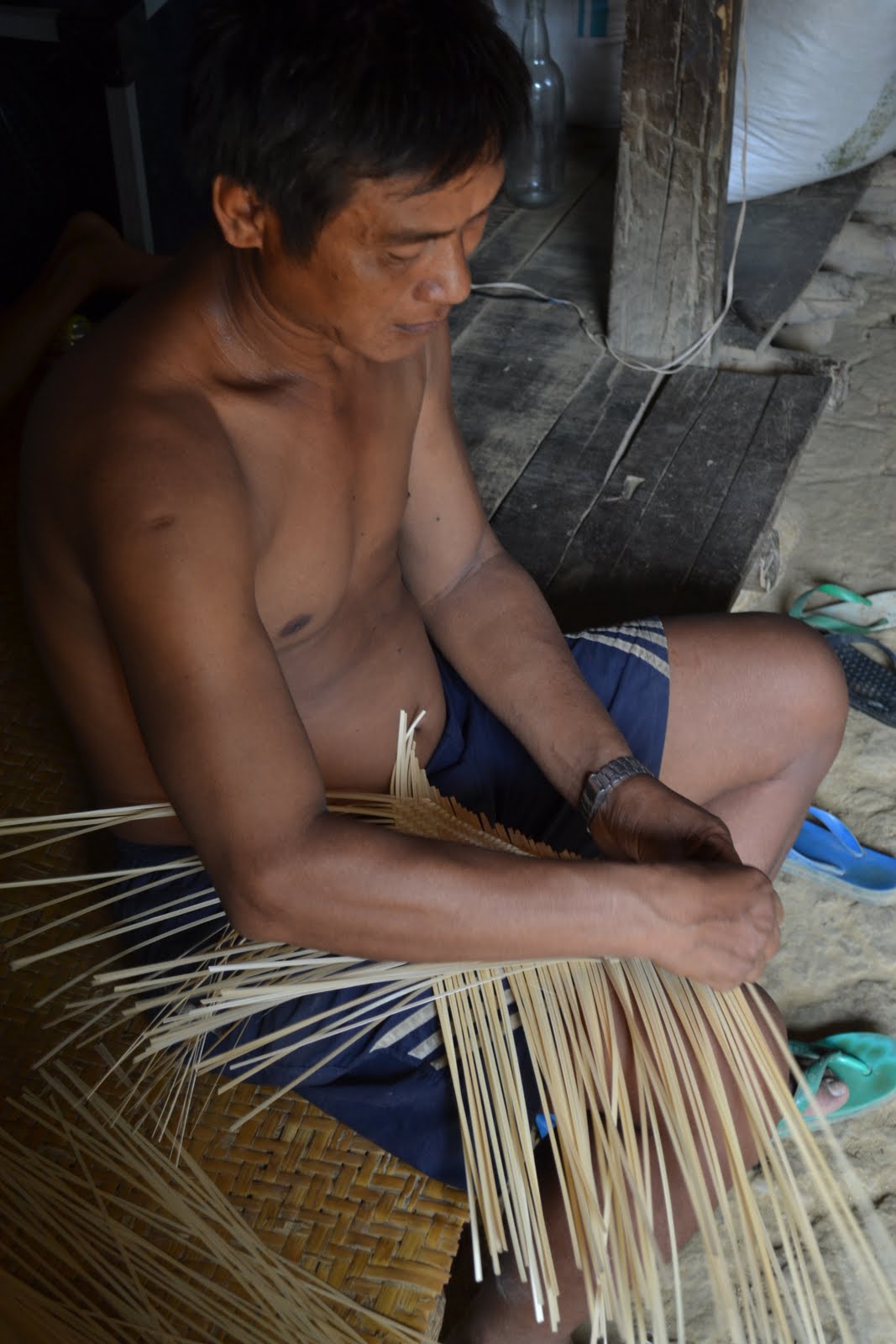

Life really is quiet in these villages—except for the roosters, chickens, and children. Along the banks of the creeks and river, puppies, chicks, ducklings, and infants all crawled along dirt paths. Fertility was in the air, from the rice paddy homes of buffalos to the village huts. There was something romantic about life in Muang Ngoi, which I decided came from sounds alone: the buzz of the generators for the few hours of electricity that came at night; the chirping of insects in the forest along the river; the sound of the river, the creeks, and the waterfalls.

My stay in Muang Ngoi was brief, but made rich by the reception of villagers, especially my guide Saan and his family. Saan welcomed me to his home for a buffalo barbeque and drinks (I ate vegetables and passed on the Lao Lao fermented rice wine), traditional rice soup for breakfast, and a glimpse at religious culture in the village. Saan had been a monk as an adolescent, and taught me the ins-and-outs of paying respects during a Theravada Buddhist festival.
Monday, September 5, 2011
Killing for Equality
In the “People’s Republic of Cambridge,” the writings of Marx are upheld as a sort of blueprint for idealist scholars. Several of my Harvard peers call themselves Marxists, inspired by a vision of equality and universalism.
For the people of Cambodia, the word “Marxism” brings back memories of one of the country’s darkest times. To explore the history of Cambodia’s Khmer Rouge and the genocide that ensued under the party’s leadership, I headed to Phnom Penh, Cambodia.
In its four years of national rule from 1975-1979, the Khmer Rouge is believed to have caused the deaths of 2 million of Cambodia’s 7.5 million civilians, making it the deadliest regime of the twentieth century. To force egalitarianism upon its populace, party leaders ordered the exodus of all urban dwellers to the rural countryside where a policy of self-sufficiency required people to produce their own rice, clothing, and medicines. In addition to the hundreds of thousands of deaths that resulted from starvation and lack of access to modern medicines, the party’s policies of torture and execution aimed at suspected capitalists depleted Cambodia of some of its most educated, famous, and prosperous members of society.
The Tuol Sleng Prison Museum is located near the center of the capital city of Phnom Penh. Once a high school, the Khmer Rouge converted the campus into a systematized torture facility and prison. During its four years of operation, an estimated 20,000 prisoners met their demise behind prison walls, with only seven known survivors.
The exterior of each of the school buildings remains covered in barbed electric wire, meant to prevent prisoners from committing suicide. The tiny cells constructed within the former classrooms appear insufficiently small to fit a resting body, sized more appropriately as coffins than prison rooms.


As each prisoner entered the facility, they were photographed and ordered to provide a full life biography. Today, the prison rooms are filled with the haunting photographic portraits of the thousands held captive and tortured within the facilities.
Just fifteen minutes outside of the city center, I visited Choeung Ek Genocidal Center, the location of the largest known mass graves in Cambodia. Here, at least 20,000 people were executed and murdered, many of them family members of those detained in Tuol Sleng prison, representing a small fraction of the estimated 1,300,000 buried in mass graves throughout Cambodia. Today, the bones of the bodies excavated at Choeung Ek are kept on display in a memorial stupa in the center of the killing fields. The land surrounding has been largely untouched since the excavations began. Grass now covers the shoveled pits where skeletal remains were removed; trees, once used to bash in the heads of infants, stand swaying in the wind; and local fishers now use the property to catch evening supper. The calm in this former place of mass violence is eerie with birds chirping and insects humming where once, the screams of thousands were heard.

It was amazing for me to learn that the Khmer Rouge party remained strong until the early 1990s, not officially dissolving until 1999, when I was ten years old. Today, the Khmer Rouge Case Trials continue, a slow effort overseen by the UN to bring justice to the Cambodian people.
I left the killing fields in silent prayer, sending peace to the spirits of Choeung Ek and praying for an end to senseless violence everywhere.
For the people of Cambodia, the word “Marxism” brings back memories of one of the country’s darkest times. To explore the history of Cambodia’s Khmer Rouge and the genocide that ensued under the party’s leadership, I headed to Phnom Penh, Cambodia.
In its four years of national rule from 1975-1979, the Khmer Rouge is believed to have caused the deaths of 2 million of Cambodia’s 7.5 million civilians, making it the deadliest regime of the twentieth century. To force egalitarianism upon its populace, party leaders ordered the exodus of all urban dwellers to the rural countryside where a policy of self-sufficiency required people to produce their own rice, clothing, and medicines. In addition to the hundreds of thousands of deaths that resulted from starvation and lack of access to modern medicines, the party’s policies of torture and execution aimed at suspected capitalists depleted Cambodia of some of its most educated, famous, and prosperous members of society.
The Tuol Sleng Prison Museum is located near the center of the capital city of Phnom Penh. Once a high school, the Khmer Rouge converted the campus into a systematized torture facility and prison. During its four years of operation, an estimated 20,000 prisoners met their demise behind prison walls, with only seven known survivors.
The exterior of each of the school buildings remains covered in barbed electric wire, meant to prevent prisoners from committing suicide. The tiny cells constructed within the former classrooms appear insufficiently small to fit a resting body, sized more appropriately as coffins than prison rooms.


As each prisoner entered the facility, they were photographed and ordered to provide a full life biography. Today, the prison rooms are filled with the haunting photographic portraits of the thousands held captive and tortured within the facilities.
Just fifteen minutes outside of the city center, I visited Choeung Ek Genocidal Center, the location of the largest known mass graves in Cambodia. Here, at least 20,000 people were executed and murdered, many of them family members of those detained in Tuol Sleng prison, representing a small fraction of the estimated 1,300,000 buried in mass graves throughout Cambodia. Today, the bones of the bodies excavated at Choeung Ek are kept on display in a memorial stupa in the center of the killing fields. The land surrounding has been largely untouched since the excavations began. Grass now covers the shoveled pits where skeletal remains were removed; trees, once used to bash in the heads of infants, stand swaying in the wind; and local fishers now use the property to catch evening supper. The calm in this former place of mass violence is eerie with birds chirping and insects humming where once, the screams of thousands were heard.

It was amazing for me to learn that the Khmer Rouge party remained strong until the early 1990s, not officially dissolving until 1999, when I was ten years old. Today, the Khmer Rouge Case Trials continue, a slow effort overseen by the UN to bring justice to the Cambodian people.
I left the killing fields in silent prayer, sending peace to the spirits of Choeung Ek and praying for an end to senseless violence everywhere.
Bombs and bonds
I made a friend in Japan who I bonded with over a discussion about bombs. Rika and I chose to spend the day together in Hiroshima, and neither of us held back as we asked questions and provided answers about the war and the atomic attack. We realized that both of our understandings of the atomic bomb were deeply rooted in the patriotic telling of history provided by our textbooks and educators which gave a single perspective in an infinite sea of war stories.
In Cambodia, I entered another former enemy’s territory. I knew little about the Vietnam War outside of what movies, popular culture, and brief mentions in history books have taught me.
In Cambodia, I learned about the War from child survivors of landmine explosions.
The Cambodian countryside appears much as I imagine it did forty years ago, with yaks still serving as a major form of transport and labor, children playing naked in water pools, and families working from dawn until dusk in the rice paddies before returning to their thatched roof huts. This tranquil setting is where the vast majority of Cambodia’s 40,000 amputees lost their limbs and where most of the estimated 4-6 million remaining undetonated devices reside.
During the War, Vietnamese used territory within Laos and Cambodia to supply troops in Vietnam. Known as the Ho Chi Minh Trail, this supply line became a main target for near-continual American bombing that resulted in the loss of an estimated 600,000 Cambodian civilian lives. Hundreds of thousands of these bombs did not detonate and still litter the countryside, making rural Cambodia one of the most dangerous places in the world to live over thirty years later.
The number of undetonated ordinances increased following the end of the Vietnam War with the rise of the Khmer Rouge. Landmines were seen as a key part of their strategy, debilitating but not killing their victims, as the economic cost of an amputee to an enemy is greater than that of a casualty.
At the Cambodia Land Mine Museum and Rescue Center, children who have lost limbs receive an education and disability care. There, in the countryside of Siem Reap, I heard the stories of children as young as five who had been picking rice or walking to school when a bomb exploded nearby. These children, forever disabled, knew nothing of the difference between communism and democracy. The stories they wished to share were not about politics or war strategies, but about the long-term impact of bombs.
As I left the museum and the smiling faces of the limbless children, I felt deep appreciation for what a blessing it is that people have openly shared with me stories from the other side, those told by child soldiers, limbless civilians, and A-bomb survivors. The stories of war continue long after the signing of peace agreements and can be heard in the voices echoing in the countryside many years later.

In Cambodia, I entered another former enemy’s territory. I knew little about the Vietnam War outside of what movies, popular culture, and brief mentions in history books have taught me.
In Cambodia, I learned about the War from child survivors of landmine explosions.
The Cambodian countryside appears much as I imagine it did forty years ago, with yaks still serving as a major form of transport and labor, children playing naked in water pools, and families working from dawn until dusk in the rice paddies before returning to their thatched roof huts. This tranquil setting is where the vast majority of Cambodia’s 40,000 amputees lost their limbs and where most of the estimated 4-6 million remaining undetonated devices reside.
During the War, Vietnamese used territory within Laos and Cambodia to supply troops in Vietnam. Known as the Ho Chi Minh Trail, this supply line became a main target for near-continual American bombing that resulted in the loss of an estimated 600,000 Cambodian civilian lives. Hundreds of thousands of these bombs did not detonate and still litter the countryside, making rural Cambodia one of the most dangerous places in the world to live over thirty years later.
The number of undetonated ordinances increased following the end of the Vietnam War with the rise of the Khmer Rouge. Landmines were seen as a key part of their strategy, debilitating but not killing their victims, as the economic cost of an amputee to an enemy is greater than that of a casualty.
At the Cambodia Land Mine Museum and Rescue Center, children who have lost limbs receive an education and disability care. There, in the countryside of Siem Reap, I heard the stories of children as young as five who had been picking rice or walking to school when a bomb exploded nearby. These children, forever disabled, knew nothing of the difference between communism and democracy. The stories they wished to share were not about politics or war strategies, but about the long-term impact of bombs.
As I left the museum and the smiling faces of the limbless children, I felt deep appreciation for what a blessing it is that people have openly shared with me stories from the other side, those told by child soldiers, limbless civilians, and A-bomb survivors. The stories of war continue long after the signing of peace agreements and can be heard in the voices echoing in the countryside many years later.

Subscribe to:
Posts (Atom)